Beef Tenderloin Recipe
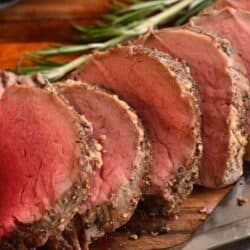
My beef tenderloin roast is tender and juicy, with a nicely browned outside and a buttery finish. I season it simply with fresh garlic, salt, and pepper, then top it with butter while it rests and spoon the pan juices over every slice. One whole tenderloin feeds 10 to 14 people, which makes it an easy centerpiece for a special occasion and holiday dinner.
Servings: 12 (can serve 10-14 people)
Calories: 574kcal
Ingredients
- 5 lb whole beef tenderloin trimmed
- 8 cloves of garlic pressed
- kosher salt
- freshly cracked black pepper
- 6-8 tbsp salted butter
Instructions
- NOTE: Most grocery stores with a butcher department can help you clean the tenderloin if you are not willing to do it yourself. You can also request a butcher to cut the tenderloin to a more desired size if needed.
Cleaning Beef Tenderloin:
- CHAIN: Although most packaged tenderloin will come without the chain, some tenderloin may still have it attached. It looks like a thin, fatty piece of meat running down the length of the entire tenderloin.It will be quite easy to spot and very easy to remove. You can actually remove it with your hands and may just been a few assist cuts along the way. Just follow it along, separating it from the tenderloin.
- SILVERSKIN: Silverskin is a tough layer of white, shimmery connective tissue that runs along the tenderloin. It MUST be removed. To remove it, pull up some of the silver skin at one end of the tenderloin and then use a thin knife to cut along the silver skin to separate it from the meat. Some silverskin will pull up just by tugging and pulling with your hands. use a knife to remove remaining pieces of silverskin but try not to remove any of the actual meat.
Tie and Season Beef Tenderloin:
- To make the tenderloin more even thickness at the thin end, cut the tip where it starts to get narrow almost all the way off but not completely off. Tuck the narrow, thin tip under the tenderloin.
- Use cooking twine to tie the tenderloin all along the whole length in about 1-inch intervals. Make sure not to tie too tight where it starts cutting into meat.
- Rub pressed garlic all over the tenderloin, on all the sides. Season generously with kosher salt and cracked pepper all over as well.
- TIP: always tie the meat before adding seasoning so the seasoning does not fall off during the tying process.
Cooking Beef Tenderloin:
- Preheat the oven to 425°F and line the bottom of the roasting pan with aluminum foil.
- Place cleaned, tied, and seasoned beef tenderloin on a rack inside the roasting pan and insert a leave-in thermometer in the center of the meat. (If you don’t have a leave-in thermometer, you will need to take the meat out of the oven to take the temperature.)
- Place the roasting pan in the oven and cook for 15 minutes at high temperature (425°F).
- Turn the oven temperature down to 325° and cook until the internal temperature is at 130°-135° for medium-rare. (Cook to 135°-140° for medium or 120°-125° for rare.) Remember that the meat continues to cook while resting under the tent, it will go up another 5° or so.
- Take the beef out of the oven. You can keep it on the rack, or place it on a large plate, or a cutting board. Place pieces of butter on top of the tenderloin, along the whole cut.
- Loosely tent it with a sheet of aluminum foil and let it rest for about 10 minutes. Cut the string off the tenderloin and let it rest another 10-15 minutes.
- Place the tenderloin onto a large cutting board and slice it against the grain. Place cut beef slices back in the plate and pour the buttery juices that were left in the pan over the top.
Video
Notes
- Trimming: if your tenderloin isn’t trimmed, my how to break down a whole beef tenderloin post has a video that walks you through it, or you can ask the butcher to trim it for you.
- Dry brine (optional): salt the tied tenderloin, set it on a wire rack inside a rimmed baking sheet, and refrigerate uncovered for at least 6 hours, up to 24 hours. Skip the salt on cooking day and use unsalted butter.
- Doneness: tenderloin is a lean cut, so it’s best cooked to medium-rare or medium at the most. The temperature rises about 5°F while it rests.
- Cook time: a 5 lb. trimmed tenderloin takes about 1 hour total. A smaller center-cut roast cooks faster, so always go by the thermometer.
- Storing: store cooled leftovers in an airtight container for about 3 days.
- Freezer: wrap slices tightly in plastic wrap, then in foil, and freeze for up to 3 months. Thaw overnight in the refrigerator.
- Reheating: preheat the oven to 350°F, wrap each slice loosely in foil, and reheat for 10-15 minutes, just until warm in the middle.
Nutrition
Calories: 574kcal | Carbohydrates: 1g | Protein: 35g | Fat: 47g | Saturated Fat: 21g | Cholesterol: 147mg | Sodium: 1306mg | Potassium: 599mg | Fiber: 1g | Sugar: 1g | Vitamin A: 182IU | Vitamin C: 1mg | Calcium: 24mg | Iron: 5mg